Abstract
Blending learning, as a reconstruction of traditional teaching, has been proved effective in providing on-line resources and flexible in time and space. Therefore, it attracts explorations from various fields and produces several successful application cases. As an important compulsory undergraduate curriculum in China, the exploration towards a more effective and efficient entrepreneurship education never ends. The difficulties in achieving its practical objectives, in learning interdisciplinary knowledge and in tailoring different learning of statuses makes blended learning necessary in developing a better entrepreneurship education. Under the circumstance, the team from College of Biochemical Engineering, Beijing Union University has spent 10 years in exploring a successful way of application and thus accumulated experience in its presentation and integration. By taking advantage of blended learning, innovation and entrepreneurship education in Beijing Union University has succeed in developing a well-organized model to solve the difficulties. With a careful selection of contents and reasonable schedule, the team can ensure the acquisition of interdisciplinary knowledge within 32 class hours of teaching. Being innovative in APP development, ways to arouse interests and final exam form and teachers’ role playing, the team has manged to make entrepreneurship education practical and better suit individuals’ demands. Its value for reference and promotion can be testified from its stable and productive performance in both participation and awards in the recent four years competitions.
Keywords
Blended Learning, Innovation and Entrepreneurship Education, Traditional Teaching, On-line Learning, Off-line Learning
1. Introduction
Traditional teaching and learning involves face-to-face interaction. It has been applied for centuries for knowledge acquisition and has been proved effective in talent cultivation though, its disadvantage - low initiative of students, inadequate involvement and cognition and extremely varied academic performance have arouse new researches on methodologies.
Blending learning, as a reconstruction of traditional teaching, has been popular in Education. By taking advantage of on-line resources, it allows teaching happen in anywhere at any time. In this case, students can be flexible in preview and review whereas teachers can focus on solving key problems with a limited time and space.
Blended learning, therefore, arouse the exploration and discussion in its application in different fields. Successful cases concerning what to be included in on-line learning and the respective proportion on-line and off-line learning take up vary in cases.
From 2012, innovation and entrepreneurship education has been included in the compulsory undergraduate curriculum system in China and thus has gradually stabilized the pyramidal model of “foundation theories-professional integration-competition practice”. Up to this day, further explorations towards a more effective and efficient model in entrepreneurship education is still on the way. In this case, trying to find out a new approach is essential and urgent in developing a better entrepreneurial education.
2. The Development of Blended Learning and Its Application
The premise of blended learning is the development of technology for it gave rise to the development of on-line resources, database, web-based course etc., thus made distance learning possible. However, on-line learning alone cannot contribute to a satisfied result, the absence of learning atmosphere may lower the learning efficiency and effectiveness of students.
In this case, both on-line resources and face-to-face interaction are essential to a good learning. So the way how they compliment each other is the key to realize a successful education concerning innovation and entrepreneurship.
2.1. The Origin and Development of Blended Learning
The exploration of blended learning started from 2000. Cooney et al. was the first to use the terminology of “blended learning” in the studies of a prekindergarten school, aiming at combining play and work
| [1] | Cooney, M. H., Gupton, P., & O’Laughlin, M. (2000). Blurring the lines of play and work to create blended classroom learning experiences. Early Childhood Education Journal, 27(3), 165-171. |
[1]
. Another study is conducted by in a high-stake course at military by Bonk et al.. The course is designed in three phrases. First of all, it focuses on the Internet-based learning, then it comes to the use of virtual collaborative chat tool. The final phrase returns to the traditional teaching and contributes to the overall teaching. The first two phrases were rather enjoyable and flexible
| [2] | Bonk, C. J., Olson, T. M., Wisher, R. A., & Orvis, K. L. (2002). Learning from focus groups: An examination of blended learning. Journal of Distance Education, 17(3), 97-118. |
[2]
. Garrison and Kanuka's describes blended learning as “the thoughtful integration of classroom face-to-face learning experiences with on-line learning experiences."
| [3] | Garrison, D. R., & Kanuka, H. (2004). Blended learning: Uncovering its transformative potential in higher education. Internet and Higher Education, 7(2), 95-105. |
[3]
Chen and Jones conduct a survey on MBA students in an accounting class and finds out that blended learning helps students appreciate the class and improves their analytical skills.
| [4] | Chen, C. C., & Jones, K. T. (2007). Blended learning vs. traditional classroom settings: Assessing effectiveness and student perceptions in an mba accounting course. The Journal of Educators Online, 4(1), 1-15. |
[4]
Chandra and Fisher show that students preferred asking questions to teacher as face to face instead of asking through email.
| [5] | Chandra, V., & Fisher, D. L. (2009). Students’ perceptions of a blended web-based learning environment. Learning Environment Research, 12, 31-44. |
[5]
So the off-line learning is indispensable for an interaction. So and Brush does a survey of 48 graduate students and further concludes that high-level social presence and collaborative learning are more satisfied with the blended course.
| [6] | Hyo-Jeong So, Thomas A. Brush (2008). Student perceptions of collaborative learning, social presence and satisfaction in a blended learning environment: relationships and critical factors. Computers & Education, 51(1), 318-336. |
[6]
Based on the initial development, blended learning has gained its popularity around the world. Recent studies succeed in exploring the effect of blended learning based on empirical studies. Xiaotian Han finds that effectiveness of blended learning is positively associated with student learning outcomes but indirectly influenced student learning outcomes through student engagement; student academic motivation serves as moderate element between student learning outcomes and effectiveness of blended learning.
| [7] | Xiaotian Han. (2025). Associations between Effectiveness of Blended Learning, Student Engagement, Student Learning Outcomes, and Student Academic Motivation in Higher Education. Education and Information Technologies, 30(8), 10535-10565. https://doi.org/10.1007/s10639-024-13246-1 |
[7]
With the development of technology, blended learning has given rise to various evolution, such as e-learning, hybrid learning, self-directed learning and even flipped classroom since then and contributes more to a better class performance.
| [8] | Hanna Truba, Olena Sytko, Maryna Arapaki, Svitlana Yelisieieva, & Olha Podlisetska. (2025). Analysis of Hybrid (Blending) Learning within the Framework of Educational Discourse. Journal of Education and Learning (EduLearn), 19(3), 1492-1500. |
| [9] | Wang, G. (2025). Effects of a Flipped Classroom College Business Course on Students’ Pre-Class Preparation, In-Class Participation, Learning, and Skills Development. Administrative Sciences (2076-3387), 15(8), 301. https://doi.org/10.3390/admsci15080301 |
[8, 9]
2.2. The Application Fields of Blended Learning
As an advanced methodology, blended learning has been successful in various fields worldwide. For example, in medical-relevant areas, Sun used a modified Technology Acceptance Model (TAM) questionnaire in "Medical Imaging" course at Hainan Medical University and showed blended learning had a positive influence on students, contributing to their satisfaction and engagement.
With the recent development of AI, blended learning has further gained its advancement. Kurniawan has integrated AI into digital project-based learning and found out that it can successfully enhance the critical thinking and problem-solving skills.
| [11] | Kurniawan, D. et al. (2025) ‘Integrating AI in Digital Project-based blended learning to enhance critical thinking and problem-solving skills’, Multidisciplinary Science Journal, 7(12), p. 2025552. https://doi.org/10.31893/multiscience.2025552 |
[11]
Ka Long Roy Chan & Jinyu Liu explores the integration of Generative Artificial Intelligence (GenAI) tools into blended learning for designing and pronunciation teaching and further introduce the potential for broader application across various language skills.
| [12] | Ka Long Roy Chan, & Jinyu Liu. (2025). Using Multiple GenAI Tools in Pronunciation Teaching: An AI-Assisted Teaching Flowchart in Blended Learning and Flipped Learning. Journal of Educators Online, 22(3). |
[12]
Guo, X. does an investigation of blended learning influence in UK accounting education. Based on the clusters identifying three distinct clusters covering “Teacher-Centred Learning Cluster”, “Self-Directed Learning Cluster” and “Minimal Engagement Cluster” characterized by above-level, high-level and low level of social and cognitive presence and reports the highest levels of self-perceived learning and course satisfaction that “Self-Directed Learning Cluster”.
3. Reasons for Exploring Blended Learning in Innovation and Entrepreneurship Education
Exploring how blended learning works in innovation and entrepreneurship education is of importance for relevant teachers and students for the following reasons.
3.1. Difficulties in Achieving Practical Objective
Different from other subjects, entrepreneurship education is aiming at the improvement of students’ application abilities. So instead of using exams to check the extent of knowledge acquisition, a presentation covering a well-planned business plan is more preferable. By doing so, students can undergo a process similar with an entrepreneur, fully displaying the program itself and its competitive edge, team members and future financing.
Based on its practical objective on practice, blended learning can shelf theoretical knowledge on the internet whereas ground application with the help from face-to-face learning and thus contributes to the engagement of students. M. Malathi and Pulidindi Venugopal conduct a study aiming to explore the relationships among student engagement, entrepreneurial education, and entrepreneurial intention among final-year university students. The result shows that with a well-structured educational programs, students’ aspirations towards entrepreneurship improve.
| [14] | Malathi, M., & Venugopal, P. (2025). Entrepreneurial intention and engagement in entrepreneurship education. Journal of Innovation & Entrepreneurship, 14(1), 1-20. https://doi.org/10.1186/s13731-025-00524-6 |
[14]
3.2. Difficulties in Learning Interdisciplinary Knowledge
Instead of the introducing a specific knowledge deepening from its surface to the most advanced status, the knowledge concerning entrepreneurship education usually covers the whole process from thinking about an entrepreneurial idea to the way how it can be realized in a business reality. Available methods for achieving innovation, the process and tips for paying tax, relevant laws and regulations shall be included in developing a business. It is almost impossible for any teachers to fill the 2-hour teaching time with all the above interdisciplinary knowledge. Therefore, in the innovation and entrepreneurship education, the expansion of class is necessary for a better performance of such a time-consuming knowledge.
What’s more, instead of randomly choosing what to learn, the order for knowledge learning is rather fixed for any business shall starts from thinking in the first place and then comes to business running for future development. It is not exaggerated to say that range of the knowledge covering all these fields are necessary for any entrepreneur to start his bushiness journey. With the involvement of blended learning, it is easy to have interdisciplinary knowledge available on Internet database and open to students to check when it is necessary.
3.3. Difficulties in Tailoring Learning Statuses
As for students, neither proactively engaging the courses nor passively waiting up for the course benefits entrepreneurship education. In proactive case, once the problems students suffer comes from future knowledge, searching for solution or asking for help may lose the time for its development. In a passive case, a scheduled arrangement may contributes learning incoherency. The regular intervals are an excellent excuse for passive learners to forget and review several times. In the above cases, it is not hard to draw the conclusion that the blended learning is indispensable for a successful entrepreneurship education for its on-line database is available to check the past knowledge and access to the future knowledge, regardless of time and location. Chuane, Q. states that by using blended learning, students can study at any time and location without any constraints. Thus, they can study at their own pace and receive immediate feedback regarding their performance.
| [15] | Chuane, Q. (2025). Conceptual framework of applying CoI-based blended learning approach to enhance students’ vocabulary and vocabulary learning motivation. PLoS ONE, 20(8), 1-31. https://doi.org/10.1371/journal.pone.0330115 |
[15]
4. Exploring Blending Learning in Innovation and Entrepreneurship Education
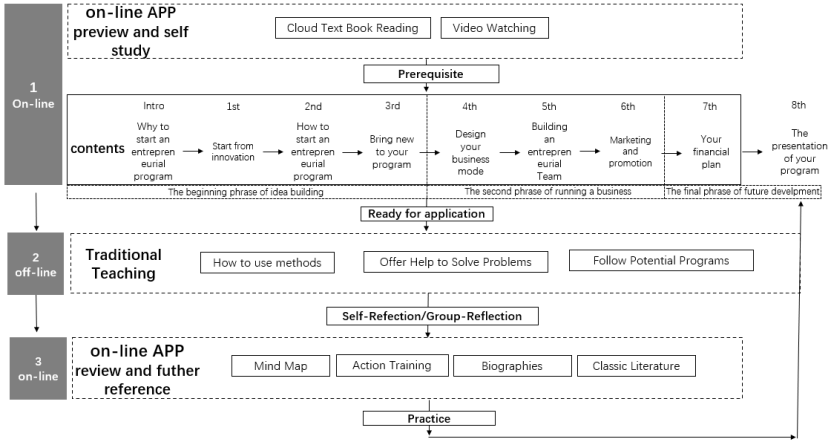
Figure 1. A full view of blended learning-based system of innovation and entrepreneurship education in College of Biochemical Engineering, Beijing Union University.
Based on the importance of blended learning in innovation and entrepreneurship education, the team from College of Biochemical Engineering, Beijing Union University has accumulated experiences in selecting what to teach and how to teach and succeed in finding a balance in on-line resources and off-line tasks from 2015-2025.
4.1. Careful Selection of Contents and Reasonable Arrangement of Schedule
To solve difficulties from interdisciplinary knowledge and end with a potential entrepreneurial program, a careful selection of what to cover and a reasonable teaching schedule are essential. With only 32 class hours to cover, the team takes advantage of blended learning and balances the on-line teaching and off-line teaching by having 4 hours per week to fully cover the progress of each program and 8 weeks to finish. In term of contents, after 10 years of experience, the teaching team has come up with 8 chapters with 3 phrases to go through. the first phrase focuses on the birth of a primitive idea. So “innovation” is the first Chapter. To further help students brainstorm a best idea, various methods for creating ideas has been introduced at the same time.
To turn a creative idea into a business is challengeable to most idea owners. And in most cases, an idea owner would prefer to “sell” his idea to a professional company or to hire an expert to do management. However, the team chooses to find a balanced way of knowing both how to create an idea and how to run it into a business for both of them are the foundation of building up entrepreneurs. So analyzing competitors, customer behaviors and market are set after the “innovation” in Chapter 2 and followed by discovering business opportunities, innovating schemes and verificating prototype in Chapter 3.
After the content concerning the program itself, business running matters in the second phrase. So Business Model Canvas is introduced as one of the methods of building a basic business modes. To make the idea as practical as possible, reliable partners and knowledge in marketing and promotion strategies are indispensable.
The final phrase is about the program’s future plan of the program and its presentation to investors, which not only requires its detailed financial and financing plan, but also needs an arena to improve his/her own presentation abilities.
To effectively trigger the a potential entrepreneurship, the team has managed to explore a successful mode with an excellent mixture of on-line and off-line learning.
4.2. Creative Designs
4.2.1. An On-line APP
The team has offered a on-line APP covering both knowledge and practice. Such a blended learning is designed to offer abundant resources for self-studying and class teaching. Besides a cloud textbook in accordance with the teaching schedule, practice and extensive reading online allows the realization of the program and solution of the problems possible in off-line teaching.
4.2.2. Various Ways of Interest Arousing
To make the on-line part interesting, the ways of knowledge presentation vary. The team has inserted videos to animate obscure theories. After students has gone through all the texts, there is a mind map available for summary and Action Training for a corresponding practice. Besides, biographies or classic literature are set up at the end of each chapter to encourage students going on with the their programs. By reading life experience of a successful entrepreneur, students therefore can learn from them and even be encouraged to go further.
4.2.3. Group Presentation as the Form for Final Exam
To create a similar situation a real entrepreneur may come across, a final presentation of their individual problems is a must. Every student has to be in a group and even involved in a business role. With proceeding with the same program, a group can work together for an integrated entrepreneurial work. The more individual responsibility one shoulders, the more on-line resources will be taken advantage of.
4.2.4. Teachers Serving as the “Assistant”
In the off-line learning, teachers take advantage of tools and methods in on-line resources and concentrate on offering help with each programs. each group to proceed in their selected programs, teachers in a blended teaching is more like a “assistant” rather than in a traditional instructor.
As the face-to-face teaching finishes, it is necessary to leave space for students to achieve self-refection so that the program they are conducting can be more perfect. In this way, Action Training in the on-line APP is also a homework for knowledge acquisition.
5. Results
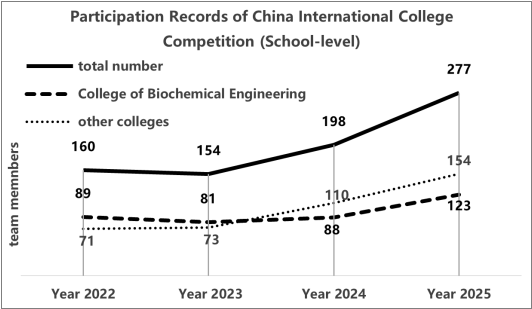
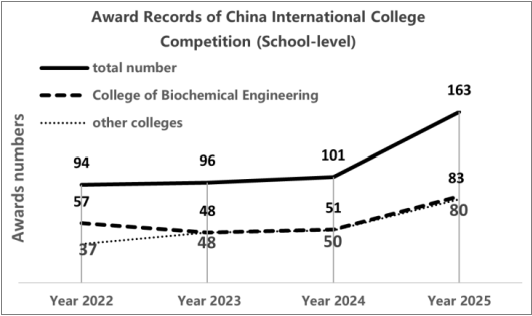
In the recent 4 years, such a successful application of blended learning has been used by other colleges of Beijing Union University. Its positive influence and replicability has been presented by the increase of participation records and award records at school-level of China International College Competition, one of the well-known competitions of entrepreneurship in China.
Figure 2. Participation Records of China International College Competition (School-level).
As it is shown above, the dramatic increase of participation has proved that the above successful mode can be promoted and duplicated. What shall be noticed more is the stable performance of the College of Biochemical Engineering. With the team has continuously perfected the application of blended learning in entrepreneurship education, it has contributed to half of the participation.
Figure 3. Award Records of China International College Competition (School-level).
As it is shown above, not only does the mode succeed in contributing the quantity of competition, it also win more awards than other participators. From the above figure, it is not hard to see the stable performance of quality College of Biochemical Engineering has been presented in the latest four years. Such a good performance, in turn, testify the effectiveness and efficiency of such a successful blended learning-based model.
6. Conclusions, Limitations and Recommendations
To summarize what has been analyzed above, it is not hard to draw the conclusion that blended learning is essential to achieve good performance in innovation and entrepreneurship education for it can effectively lengthen the learning time and expand the learning space and contribute to the achievement of self-teaching and self-reflection. On the other hand, it alleviates what teachers has burdened in traditional teaching for the essence of the entrepreneurship is hard to consume. The teaching mode the team from College of Biochemical Engineering, Beijing Union University has established has come to a relatively positive result. What shall be noticed is that in the latest 4 years, with the mode being applied by other colleges, both the quantity and quality in China International College Competition (School-level) has witnessed a dramatic increase, which proved the promotional value of such a mode.
Due to the time period of applying such a mode, data beyond the Beijing Union University has yet to be applied and reported back. Therefore, It is hoped that the findings of this study can lighten those researches on more application and thus find out the reason why such a mode can be successfully applied in innovation and entrepreneurship education.
Author Contributions
Ruijia Xie: Visualization, Writing – original draft, Writing – review & editing
Huiqin Duan: Methodology, Software, Supervision
Ning Ma: Funding acquisition, Project administration
Peng Li: Conceptualization, Data curation, Formal Analysis, Resources
Funding
This article is the conclusion result of “Promotion and Application of Blended Teaching Mode Based on the Course of ‘Innovation and Entrepreneurship Education’” [2024 Education and Teaching Research and Reform Project of Beijing Union University] (Project Number: JJ2024Y062).
Conflicts of Interest
The authors declare no conflict of interest.
References
| [1] |
Cooney, M. H., Gupton, P., & O’Laughlin, M. (2000). Blurring the lines of play and work to create blended classroom learning experiences. Early Childhood Education Journal, 27(3), 165-171.
|
| [2] |
Bonk, C. J., Olson, T. M., Wisher, R. A., & Orvis, K. L. (2002). Learning from focus groups: An examination of blended learning. Journal of Distance Education, 17(3), 97-118.
|
| [3] |
Garrison, D. R., & Kanuka, H. (2004). Blended learning: Uncovering its transformative potential in higher education. Internet and Higher Education, 7(2), 95-105.
|
| [4] |
Chen, C. C., & Jones, K. T. (2007). Blended learning vs. traditional classroom settings: Assessing effectiveness and student perceptions in an mba accounting course. The Journal of Educators Online, 4(1), 1-15.
|
| [5] |
Chandra, V., & Fisher, D. L. (2009). Students’ perceptions of a blended web-based learning environment. Learning Environment Research, 12, 31-44.
|
| [6] |
Hyo-Jeong So, Thomas A. Brush (2008). Student perceptions of collaborative learning, social presence and satisfaction in a blended learning environment: relationships and critical factors. Computers & Education, 51(1), 318-336.
|
| [7] |
Xiaotian Han. (2025). Associations between Effectiveness of Blended Learning, Student Engagement, Student Learning Outcomes, and Student Academic Motivation in Higher Education. Education and Information Technologies, 30(8), 10535-10565.
https://doi.org/10.1007/s10639-024-13246-1
|
| [8] |
Hanna Truba, Olena Sytko, Maryna Arapaki, Svitlana Yelisieieva, & Olha Podlisetska. (2025). Analysis of Hybrid (Blending) Learning within the Framework of Educational Discourse. Journal of Education and Learning (EduLearn), 19(3), 1492-1500.
|
| [9] |
Wang, G. (2025). Effects of a Flipped Classroom College Business Course on Students’ Pre-Class Preparation, In-Class Participation, Learning, and Skills Development. Administrative Sciences (2076-3387), 15(8), 301.
https://doi.org/10.3390/admsci15080301
|
| [10] |
Sun, X. et al. (2025) ‘Application and effectiveness of blended learning in medical imaging via the Technology Acceptance Model’, BMC Medical Education, 25(1).
https://doi.org/10.1186/s12909-025-07293-6
|
| [11] |
Kurniawan, D. et al. (2025) ‘Integrating AI in Digital Project-based blended learning to enhance critical thinking and problem-solving skills’, Multidisciplinary Science Journal, 7(12), p. 2025552.
https://doi.org/10.31893/multiscience.2025552
|
| [12] |
Ka Long Roy Chan, & Jinyu Liu. (2025). Using Multiple GenAI Tools in Pronunciation Teaching: An AI-Assisted Teaching Flowchart in Blended Learning and Flipped Learning. Journal of Educators Online, 22(3).
|
| [13] |
Guo, X. (2025). Investigating the diversity of student experiences in blended learning in accounting education: a cluster analysis. Accounting Education, 1-21.
https://doi.org/10.1080/09639284.2025.2541411
|
| [14] |
Malathi, M., & Venugopal, P. (2025). Entrepreneurial intention and engagement in entrepreneurship education. Journal of Innovation & Entrepreneurship, 14(1), 1-20.
https://doi.org/10.1186/s13731-025-00524-6
|
| [15] |
Chuane, Q. (2025). Conceptual framework of applying CoI-based blended learning approach to enhance students’ vocabulary and vocabulary learning motivation. PLoS ONE, 20(8), 1-31.
https://doi.org/10.1371/journal.pone.0330115
|
Cite This Article
-
APA Style
Xie, R., Duan, H., Ma, N., Li, P. (2025). The Application of Blended Learning in Innovation and Entrepreneurship Education: Theoretical Foundations, Design Principles and Results. Education Journal, 14(5), 264-269. https://doi.org/10.11648/j.edu.20251405.16
 Copy
|
Copy
|
 Download
ACS Style
Xie, R.; Duan, H.; Ma, N.; Li, P. The Application of Blended Learning in Innovation and Entrepreneurship Education: Theoretical Foundations, Design Principles and Results. Educ. J. 2025, 14(5), 264-269. doi: 10.11648/j.edu.20251405.16
Copy
|
Download
AMA Style
Xie R, Duan H, Ma N, Li P. The Application of Blended Learning in Innovation and Entrepreneurship Education: Theoretical Foundations, Design Principles and Results. Educ J. 2025;14(5):264-269. doi: 10.11648/j.edu.20251405.16
Copy
|
Download
-
@article{10.11648/j.edu.20251405.16,
  author = {Ruijia Xie and Huiqin Duan and Ning Ma and Peng Li},
  title = {The Application of Blended Learning in Innovation and Entrepreneurship Education: Theoretical Foundations, Design Principles and Results
},
  journal = {Education Journal},
  volume = {14},
  number = {5},
  pages = {264-269},
  doi = {10.11648/j.edu.20251405.16},
  url = {https://doi.org/10.11648/j.edu.20251405.16},
  eprint = {https://article.sciencepublishinggroup.com/pdf/10.11648.j.edu.20251405.16},
  abstract = {Blending learning, as a reconstruction of traditional teaching, has been proved effective in providing on-line resources and flexible in time and space. Therefore, it attracts explorations from various fields and produces several successful application cases. As an important compulsory undergraduate curriculum in China, the exploration towards a more effective and efficient entrepreneurship education never ends. The difficulties in achieving its practical objectives, in learning interdisciplinary knowledge and in tailoring different learning of statuses makes blended learning necessary in developing a better entrepreneurship education. Under the circumstance, the team from College of Biochemical Engineering, Beijing Union University has spent 10 years in exploring a successful way of application and thus accumulated experience in its presentation and integration. By taking advantage of blended learning, innovation and entrepreneurship education in Beijing Union University has succeed in developing a well-organized model to solve the difficulties. With a careful selection of contents and reasonable schedule, the team can ensure the acquisition of interdisciplinary knowledge within 32 class hours of teaching. Being innovative in APP development, ways to arouse interests and final exam form and teachers’ role playing, the team has manged to make entrepreneurship education practical and better suit individuals’ demands. Its value for reference and promotion can be testified from its stable and productive performance in both participation and awards in the recent four years competitions.
},
 year = {2025}
}
Copy
|
Download
-
TY  - JOUR
T1  - The Application of Blended Learning in Innovation and Entrepreneurship Education: Theoretical Foundations, Design Principles and Results

AU  - Ruijia Xie
AU  - Huiqin Duan
AU  - Ning Ma
AU  - Peng Li
Y1  - 2025/10/30
PY  - 2025
N1  - https://doi.org/10.11648/j.edu.20251405.16
DO  - 10.11648/j.edu.20251405.16
T2  - Education Journal
JF  - Education Journal
JO  - Education Journal
SP  - 264
EP  - 269
PB  - Science Publishing Group
SN  - 2327-2619
UR  - https://doi.org/10.11648/j.edu.20251405.16
AB  - Blending learning, as a reconstruction of traditional teaching, has been proved effective in providing on-line resources and flexible in time and space. Therefore, it attracts explorations from various fields and produces several successful application cases. As an important compulsory undergraduate curriculum in China, the exploration towards a more effective and efficient entrepreneurship education never ends. The difficulties in achieving its practical objectives, in learning interdisciplinary knowledge and in tailoring different learning of statuses makes blended learning necessary in developing a better entrepreneurship education. Under the circumstance, the team from College of Biochemical Engineering, Beijing Union University has spent 10 years in exploring a successful way of application and thus accumulated experience in its presentation and integration. By taking advantage of blended learning, innovation and entrepreneurship education in Beijing Union University has succeed in developing a well-organized model to solve the difficulties. With a careful selection of contents and reasonable schedule, the team can ensure the acquisition of interdisciplinary knowledge within 32 class hours of teaching. Being innovative in APP development, ways to arouse interests and final exam form and teachers’ role playing, the team has manged to make entrepreneurship education practical and better suit individuals’ demands. Its value for reference and promotion can be testified from its stable and productive performance in both participation and awards in the recent four years competitions.

VL  - 14
IS  - 5
ER  -
Copy
|
Download






 Share This Article
 Twitter
 Linked In
 Facebook